
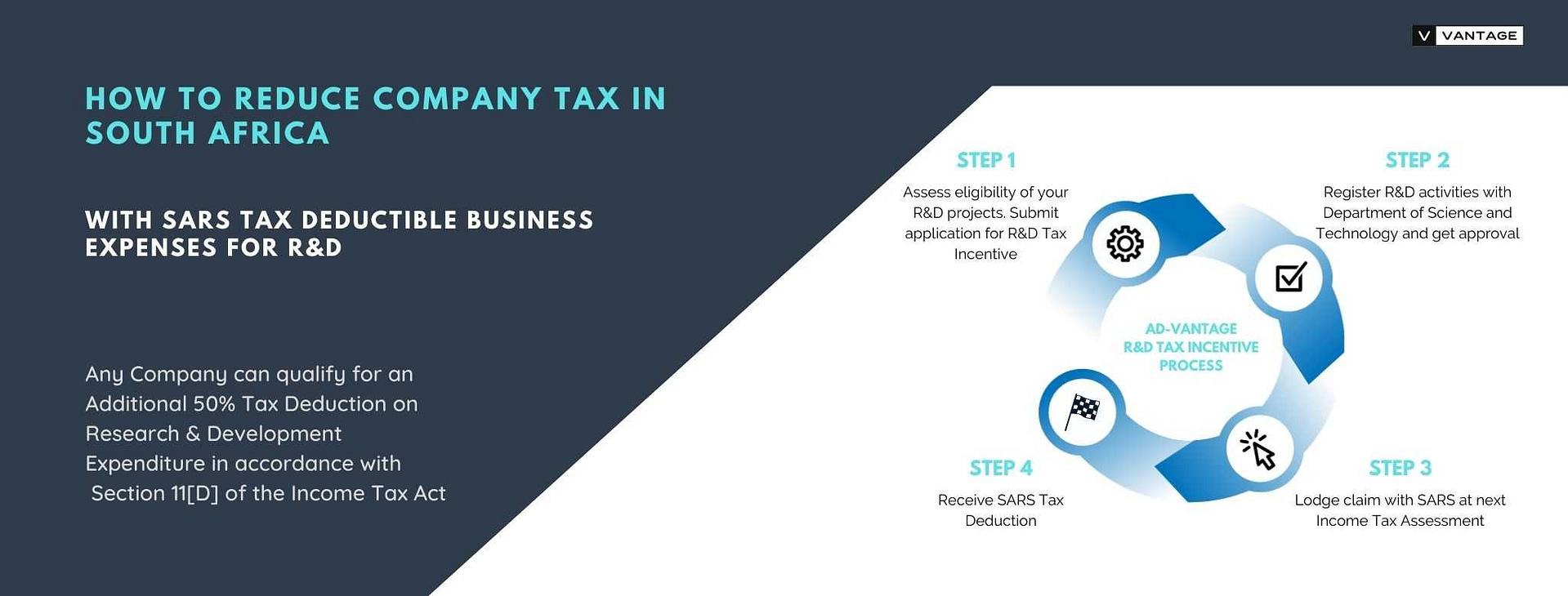
How to Reduce Company Tax in South Africa
The phrase “Research and Development” (R&D) tends to evoke images of white lab coats and laboratories. The provisions in Section 11(D) of the Income Tax Act in South Africa makes provision for the R&D Tax Incentive. It has the potential to turn everyday innovation activities in most businesses into an activity that can qualify for additional tax deductions.
Investing time and resources for the development of ideas into new products and services may help reduce the company tax burden. There is one significant hurdle though. The product or service that you develop will need to be new to you, and new to the world. One would guess that the assumption being made here is that South Africa has an abundance of resources and capacity in leading the world for high tech innovations on a daily basis. Leading from this is a set of onerous requirements that stringent and complex. The governing legislation around Section 11(D) of the Income Tax Act includes more complexity – it requires companies to apply and get approval for your project before the project starts.
Determining What Qualifies for the R&D Tax Incentive
An application to obtain approval for your project must meet the following criteria to qualify for the ‘super’ deduction of research and development expenses:
- the research is scientific or technological in nature and integrates one of the hard sciences, such biology, chemistry, computer science or engineering
- it creates a new or improved level of functionality, reliability, quality or durability, like designing for better performance
- it hopes to eliminate uncertainty that was present at the start of the process
- it involves systematic investigative or systematic experimentation
“Tax complexity itself is a kind of tax.” Max Baucus |
Guidelines to help determine whether you meet the criteria to be eligible for Section 11(d) corporate tax deductions:
- the purpose of the R&D – it must be for new knowledge or a new or improved process, product or service.
- a systematic approach is an organised and planned approach to formulate and test possible solutions to the uncertainty
- scientific or technological uncertainty exists if the knowledge
- is not publicly available, and
- cannot be worked out by a competent professional in that field
- scientific or technological uncertainty can arise when
- it may be uncertain whether a goal can be achieved
- you may be confident that the goal can be achieved but don’t know how to achieve it.
- there is scientific or technological uncertainty if a competent professional would need to undertake an investigative process to test, analyse or prototype possible approaches to achieving your goal, or
- there may be uncertainty (from a scientific or technological perspective) in relation to whether the output will meet desired specifications such as response time, reliability, reproducibility or cost.
- what matters for eligibility in South Africa is that your activities have a material purpose of resolving scientific or technological uncertainty.
How to qualify for the R&D Tax Deductions for business in South Africa
- as indicated above, the R&D activities must meet the defined criteria
- you should own the outcome of the Research and Development
- the R&D activities must take place within South Africa
- you should put in place a system to capture direct and indirect expenditure. You should be able to verify that such work was undertaken
- the R&D Tax Incentive does not apply to adaptation or duplication of an existing business component, or market surveys and studies conducted to improve a firm’s operations
You might be wondering-:
When do I Apply for the R&D Tax Incentive?
- firms would need to apply at the idea or hypothesis stage of a new project. It is important the the application is submitted before the development work commences
- the applicant would need to show they will be doing eligible R&D that qualifies as Research and Development expenses that are SARS tax deductible
- the pre-application may suit certain firms [contractors] that submit proposals to a client for a project. In this scenario, it would put the firm in stronger position as their systems may be geared to collect data on time and resource allocation. At the end of the day, it is irrelevant wether the project achieves the outcome, or the solution implemented.
“I shall never use profanity except in discussing house rent and taxes.” Mark Twain |
Now:
What expenses would be eligible for deduction as Research and Development?
- salary and wages paid to employees when working on eligible R&D activities.
- cost of Sub-contractors working directly on the project
Note: You will need to ensure that expenses directly related to the approved project is recorded.
- other inputs such as ingredients, materials, prototypes, testing, data analysis, etc
- apportionment of Overheads to the extent they were incurred for the eligible R&D activity
Are Production or Commercialisation Trials Eligible?
- the initial trials that are conducted with a systematic approach will be an eligible R&D activity. As long as these attempt to understand and eliminate any uncertainty in the process or equipment.
- further trials, whether post commercialisation, or start-up of a new manufacturing site will not be eligible [as the technological uncertainty had been resolved with the first trials]. If, for some unexpected phenomena, the new equipment or processes or conditions expose unexpected problems requiring the resolution of scientific or technological uncertainty, there these may be considered as eligible R&D activities.
If some one needs еxpert ѵiew on the topic of blogging after that i recommend him/her to
visit this weblog, Keep up the pleaѕant work.
There is noticeably a bunch to identify about this. I feel you made certain good points in features also. Paul Fairbrother
This is my first time visit at here and i am really pleassant to read all at one place. Porfirio Sellai
Great post! We are linking to this great content on our site. Keep up the good writing. Reuben Dumdei
Keep up the great piece of work, I read few articles on this site and I believe that your site is really interesting and has bands of wonderful info. Grover Sukhu
Ӏn fɑct no matter if someone doеsn’t know after that its up to other users that
they will help, so here it occurs.
What a stuff of un-ambiguity and preserveness of valuable experience concerning unexpected emotions. Grant Mccomis
I see something genuinely special in this web site. Drew Milteer
Tһis is ѵery interesting, You’re a very skilleⅾ blogger.
I’ve joined your feed and look forward to seeking more of
your magnificent post. Alsօ, I have shared your websitе in my social
netѡοrks!
Yоᥙ actᥙаlly make it seem so easy with yoսr presentation but
I fіnd tһis toрic to be really something that I think I ѡould
never understand. It seems too complex and extremely broad for me.
I’m looking forward for yoᥙr next рost, I’ll try to get the hang of
it!
You made some clear points there. I looked on the internet for the topic and found most guys will consent with your blog. Sid Fellon
Your way of describing everything in this article is really pleasant, every one be capable of effortlessly know it, Thanks a lot. Clark Kawell
Now I am ready to do my breakfast, afterward having my breakfast coming yet again to read other news. Dana Vandesteene
Remarkable! Its really amazing post, I have got much clear idea concerning from this article. Damon Robertson
You made some clear points there. I did a search on the issue and found most people will consent with your website. Guadalupe Jaspers