
What is Research and Development [R&D]?
Research and Development plays a key role in driving innovation.
The aim of R&D is to discover or create new knowledge. The new knowledge is then applied to create new products, processes, and services.
Innovation, in a business context, seeks to introduce something new. One way it achieves this is by transforming an idea together with knowledge from R&D into a product or service. This in turn creates value for which customers will pay.
R&D is an important contributor to innovation. This can lead to a company developing a competitive advantage.
Is my company undertaking R&D?
R&D does not only take place in a laboratory. Nor does it only take place at Tesla or SpaceX or Apple. R&D is taking place whenever a company looks to improve something or come up with something new. By investigating new materials, ingredients and components, we can innovate. This innovation leads to improved functionality, reduced costs and improved performance. R&D is taking place in almost every industry from FMCG, Healthcare, Engineering, Software, and so on.
“Today, it takes more brains and effort to make out the income-tax form than it does to make the income.” Alfred E. Neuman |
What is R&D?
The aim of academic R&D is to get new knowledge. This new knowledge may or may not be applied to practical uses.
The aim of industrial R&D is to get new knowledge that is relevant to the company’s business needs. The application of this knowledge leads to new and improved products, processes, systems or services. Once again, these innovations can increase the company’s sales and profits.
The National Science Foundation (NSF) defines three types of R&D:
- Basic research
- Applied research
- Development
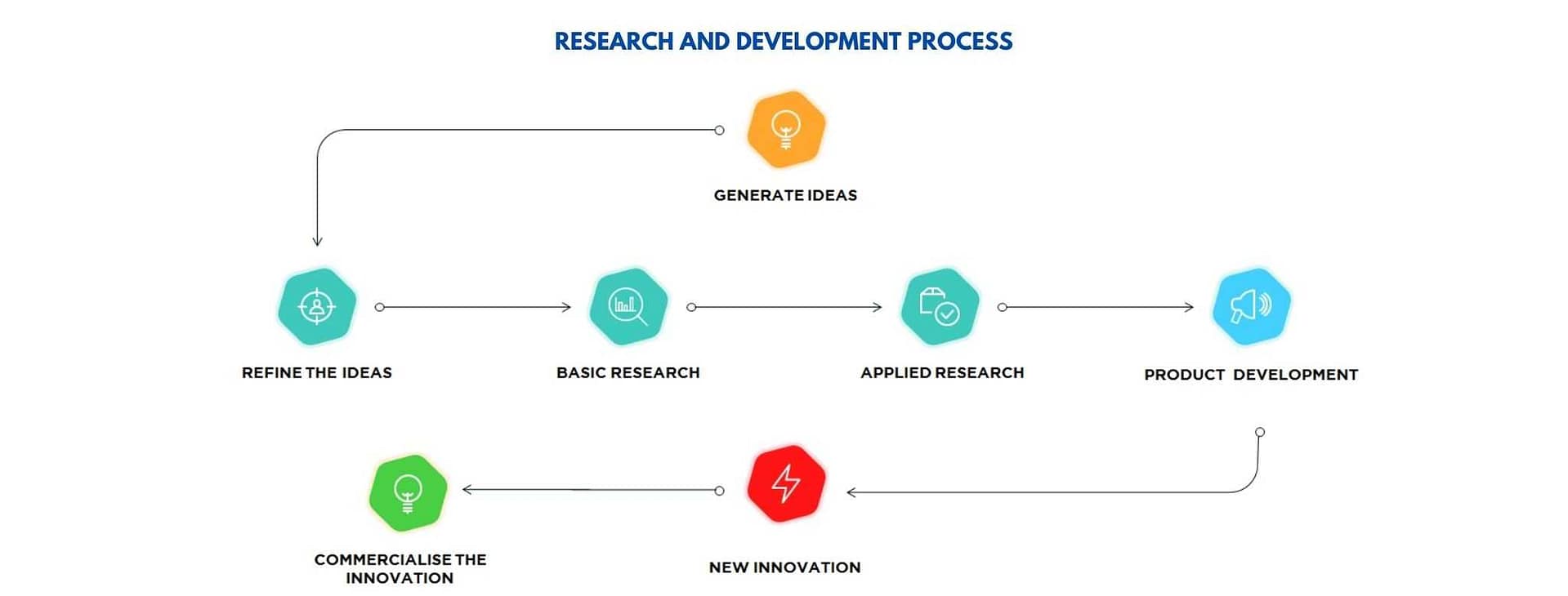
BASIC RESEARCH is aimed at advancing scientific knowledge but does not have a specific commercial goal
APPLIED RESEARCH is research directed to the discovery of new knowledge. This has specific commercial objectives on products, processes, or services.
DEVELOPMENT is the systematic application of the knowledge, discoveries or understanding gained from research toward the production of useful materials, devices, systems, or methods. This includes the design and development of prototypes and processes
It may be appropriate to distinguish between development and engineering. We could say that engineering is the application of state-of-the-art knowledge to the design and production of marketable goods.
Research creates the knowledge, and development designs and builds prototypes and proves their feasibility. Engineering then converts these prototypes into products that can be offered to the marketplace or into processes that can be used to produce commercial products and services.
What is R&D activity?
A difficulty remains in determining whether an activity is regarded as an R&D activity.
According to the Frascati Manual (2015), a R&D activity is distinguished from a non-R&D activity if five core criteria are satisfied. The activity must be:
- novel – aimed at new findings
- creative – based on original, non-obvious concepts and hypotheses
- uncertain – there is uncertainty on whether the final outcome is achievable
- systematic – it needs to be structured, planned and budgeted for
- transferable and/or reproducible – leads to results that could be reproduced
According to the Frascati Manual (2015) “All five criteria must be met, at least in principle, every time an R&D activity is undertaken whether on a continuous or occasional basis.”
What are R&D capabilities?
R&D can be conducted in-house, under contract with external service providers, or with others entities. In-house R&D affords a strategic advantage: the company is the sole owner of the knowledge and technology created and can protect it from unauthorized use. R&D is also a learning process. In-house research thus develops capability, by training the company’s own R&D people.
External R&D is usually contracted out to academic institutions, specialised non-profit research institutions, or external contractors. These entities often have experienced personnel in the disciplines of science and technology. The downside is that the company will not enjoy the learning experience and may become dependent on the contractor. Using universities can be a cost-efficient approach, and may benefit both parties as students and academic professionals can get exposure to industries, and build long-term partnerships.
Through joint R&D, several companies with shared interests join together to perform R&D, either in a separate organisation or in a university. The advantages are lower costs, since each company does not have to invest in similar equipment, researchers or resources. One of the downsides may be that all the sponsors have access to the same knowledge and technology.
“A person doesn’t know how much he has to be thankful for until he has to pay taxes on it.” Anonymous |
Factors influencing R&D
Research and development are usually thrown together as one concept, but in reality they are somewhat distinct processes. Research is considered to be science-oriented whereas development is the mechanism for translating the science into commercial products and services. Basic science can be thought of as the engine for pushing new discoveries and ideas into society – Science Push. This is in contrast to the concept of market pull. Market pull is the process of translating the basic science into products and services to meet customer needs, wants, and demands. The interaction between science push and market pull creates a very powerful feedback loop that spurs on the development and diffusion of new products and services.
How is R&D linked to innovation?
R&D activities are a subset of innovation. R&D represents the activities that companies undertake to help innovate and introduce new products and services or to improve their existing offerings. The outcome of R&D may lead to patents, designs or copyrights as discoveries and inventions are made, and products or services created.
An innovation is a new or improved product or process (or combination thereof) that differs from the firm’s previous products or processes and that has been made available to potential users (product) or brought into use by the firm (process).
A product innovation is a new or improved good or service that differs from the firm’s previous goods or services and that has been introduced on the market.
Innovation activities include all developmental, financial and commercial activities undertaken by a firm that are intended to result in an innovation for the firm.