How to reduce company tax in South Africa?

R&D Tax Incentive

How to Reduce Company Tax in South Africa

The phrase “Research and Development” (R&D) tends to evoke images of white lab coats and laboratories. The provisions in Section 11(D) of the Income Tax Act in South Africa makes provision for the R&D Tax Incentive. It has the potential to turn everyday innovation activities in most businesses into an activity that can qualify for additional tax deductions.


Investing time and resources for the development of ideas into new products and services may help reduce the company tax burden. There is one significant hurdle though. The product or service that you develop will need to be new to you, and new to the world. One would guess that the assumption being made here is that South Africa has an abundance of resources and capacity in leading the world for high tech innovations on a daily basis. Leading from this is a set of onerous requirements that stringent and complex. The governing legislation around Section 11(D) of the Income Tax Act includes more complexity – it requires companies to apply and get approval for your project before the project starts.


Determining What Qualifies for the R&D Tax Incentive
An application to obtain approval for your project must meet the following criteria to qualify for the ‘super’ deduction of research and development expenses:

  1. the research is scientific or technological in nature and integrates one of the hard sciences, such biology, chemistry, computer science or engineering
  2. it creates a new or improved level of functionality, reliability, quality or durability, like designing for better performance
  3. it hopes to eliminate uncertainty that was present at the start of the process
  4. it involves systematic investigative or systematic experimentation

“Tax complexity itself is a kind of tax.”

Max Baucus


Guidelines to help determine whether you meet the criteria to be eligible for Section 11(d) corporate tax deductions:

  • the purpose of the R&D – it must be for new knowledge or a new or improved process, product or service.
  • a systematic approach is an organised and planned approach to formulate and test possible solutions to the uncertainty
  • scientific or technological uncertainty exists if the knowledge
    • is not publicly available, and
    • cannot be worked out by a competent professional in that field
  • scientific or technological uncertainty can arise when
    • it may be uncertain whether a goal can be achieved
    • you may be confident that the goal can be achieved but don’t know how to achieve it.
  • there is scientific or technological uncertainty if a competent professional would need to undertake an investigative process to test, analyse or prototype possible approaches to achieving your goal, or
  • there may be uncertainty (from a scientific or technological perspective) in relation to whether the output will meet desired specifications such as response time, reliability, reproducibility or cost.
  • what matters for eligibility in South Africa is that your activities have a material purpose of resolving scientific or technological uncertainty.


How to qualify for the R&D Tax Deductions for business in South Africa

  • as indicated above, the R&D activities must meet the defined criteria
  • you should own the outcome of the Research and Development
  • the R&D activities must take place within South Africa
  • you should put in place a system to capture direct and indirect expenditure. You should be able to verify that such work was undertaken
  • the R&D Tax Incentive does not apply to adaptation or duplication of an existing business component, or market surveys and studies conducted to improve a firm’s operations


You might be wondering-:

When do I Apply for the R&D Tax Incentive?

  • firms would need to apply at the idea or hypothesis stage of a new project. It is important the the application is submitted before the development work commences
  • the applicant would need to show they will be doing eligible R&D that qualifies as Research and Development expenses that are SARS tax deductible
  • the pre-application may suit certain firms [contractors] that submit proposals to a client for a project. In this scenario, it would put the firm in stronger position as their systems may be geared to collect data on time and resource allocation. At the end of the day, it is irrelevant wether the project achieves the outcome, or the solution implemented.


“I shall never use profanity except in discussing house rent and taxes.”

Mark Twain


Now:

What expenses would be eligible for deduction as Research and Development?

  • salary and wages paid to employees when working on eligible R&D activities.
  • cost of Sub-contractors working directly on the project

Note: You will need to ensure that expenses directly related to the approved project is recorded.

  • other inputs such as ingredients, materials, prototypes, testing, data analysis, etc
  • apportionment of Overheads to the extent they were incurred for the eligible R&D activity


Are Production or Commercialisation Trials Eligible?

  • the initial trials that are conducted with a systematic approach will be an eligible R&D activity. As long as these attempt to understand and eliminate any uncertainty in the process or equipment.
  • further trials, whether post commercialisation, or start-up of a new manufacturing site will not be eligible [as the technological uncertainty had been resolved with the first trials]. If, for some unexpected phenomena, the new equipment or processes or conditions expose unexpected problems requiring the resolution of scientific or technological uncertainty, there these may be considered as eligible R&D activities.

It’s time for the Food & Beverage Industry to Wine & Dine – courtesy of the South African R&D Tax Incentive

It’s time for the food and beverage industry to wine and dine, courtesy of South African R&D Tax Incentive.

The aim of the R&D Tax Incentive is to promote private sector investment in Research and Development. Companies investing in R&D will be rewarded with an additional 50% deduction on Operational R&D expenses, amongst other benefits. As scientists and professionals in the field of Product Development, it is common knowledge that the innovation process is complex and technical starting from concept development of a new product, research, experimentation, new processing and manufacturing methods, quality and testing improvements, and meeting regulatory requirements.

Research and Development in the food and Beverage industries takes into account a host of capabilities from chemistry, nutritional science, biochemistry, materials science, and a host of engineering disciplines to bring a novel product to market. Whilst much of what consumers see and taste are mostly aesthetic, the scientists and engineers behind the product development know and understand this to be very different. It is highly technical and food and beverage companies invest significant resources to stay competitive and meets the needs of demanding consumers.

In order to stay competitive, manufacturers need to understand consumer preferences and offer consumer-preferred food and beverage products. These products also need to satisfy broader needs, such as regulatory and environmental considerations. There are a myriad R&D activities necessary to meet the needs of consumers, customers, legislation, cultural, sensory, nutritional, aesthetic, quality and safety requirements.


“Some taxpayers close their eyes, some stop their ears, some shut their mouths, but all pay through the nose.”

Evan Esar


More recently, the food and beverage is under further pressure from climate change challenges to regulatory challenges to dietary and wellness challenges. The South African R&D Tax Incentive rewards companies undertaking R&D in these sectors. It is not important what the size of your company is or whether the R&D or innovation was a success or not. The criteria to qualify is defined in Section 11D of the Income Tax Act.

The R&D Tax Incentive covers the innovation process from basic research to applied research and product development. This will include research and development on new ingredients such as alternative preservatives, sweetening systems, salt reduction, allergen management, new functional ingredients. The food and beverage products will also need to satisfy certain cultural or dietary restrictions such as vegan, keto, lactose, sugar and zero sugars. This list is endless, but you get the point that R&D is necessary throughout the product innovation process from idea and concept development until commercialisation of the product.

Read more about the benefits of the South African R&D Tax Incentive for manufacturing companies


What is the R&D Tax Incentive – for Food and Beverage companies in South Africa?

The R&D Tax Incentive in South Africa is provided for in Section 11(d) of Income Tax Act. The SA R&D Tax Incentive reduces the after-tax cost of R&D conducted by companies. The Tax Incentive or Tax allowance in SA allow firms investing in R&D to deduct more from their taxable income than they actually spend on R&D. The tax Incentive is a deduction from taxable income that allows companies to deduct an additional 50% for R&D Operational expenses. The value of a tax allowance depends on the corporate income tax rate. At a corporate tax rate of 28% in SA, this translates to a 14% tax benefit from SARS. A company that invests R1 million on R&D can obtain a tax benefit of R140k.  There are no limits: there is no cap [floor or ceiling] on the absolute amount of R&D that can be claimed; or a cap on the maximum amount of the tax incentive that can be deducted.

An unused tax allowances in the year of assessment may be carried forward to offset future tax under normal loss carryforward provisions. Allowing the tax allowance to be carried-over increases its value to firms incurring losses in a given year, particularly smaller companies that are unable to make a current tax claim or tax credit due to insufficient taxable income.

Most manufacturers involved with food & beverages are simply unaware that their investment in Research and Development can qualify for the South African Research and Development Tax Incentive. Some examples of Research and Development activities in the food and beverage industry:

  • New product or manufacturing process development
  • Ingredient research. Consideration of new ingredients. Salt and fat reduction. Fortification. Shelf life enhancement. New and more efficient processing. New preservation techniques and ingredients.
  • Shelf life analysis or testing
  • New Packaging developments to take into account environmental and food safety requirements
  • Formulating with new ingredients to achieve sensory or nutritional requirements
  • Package design for functional and aesthetic reasons as: improving shelf life, improve handling and storage, manufacturing handling and compatibility
  • Developing or improving manufacturing and packaging processes
  • Development of prototypes, running pilot trials and testing
  • New product certification requirements
  • Track and trace that may include software development and new data and monitoring systems


“The best things in life are free, but sooner or later the government will find a way to tax them.”

Anonymous


Potentially Qualifying R&D Jobs may include:

  • Food Scientists and Nutritionists
  • Chemist and Biologists
  • Food Technologists
  • Product Development Scientists
  • Process and Manufacturing Engineers
  • Packaging Engineers
  • Quality Assurance Technicians


How do you write-off research and development in the Food and Beverage industry in South Africa?

Yes, claiming for R&D Tax Incentive will require an investment of time, resources and expertise. Once the ball is rolling, it will reward the business with significant financial and operational benefits. Even if your company is currently operating at a loss, you will still benefit from the carryforward R&D allowances that can be carried forward indefinitely and used when the company is profitable. And, if your company were to be sold at some point in the future, the accumulated allowance may be considered as an asset when negotiating the sale of the business.

The South African R&D Tax Incentive provides a volume-based tax allowance each year for companies investing in R&D activities related to the development of new or improved products and processes. These benefits reduce your taxable income, improve your cash flow so that you could invest in more R&D, hire more R&D staff, or invest in developing your business further.

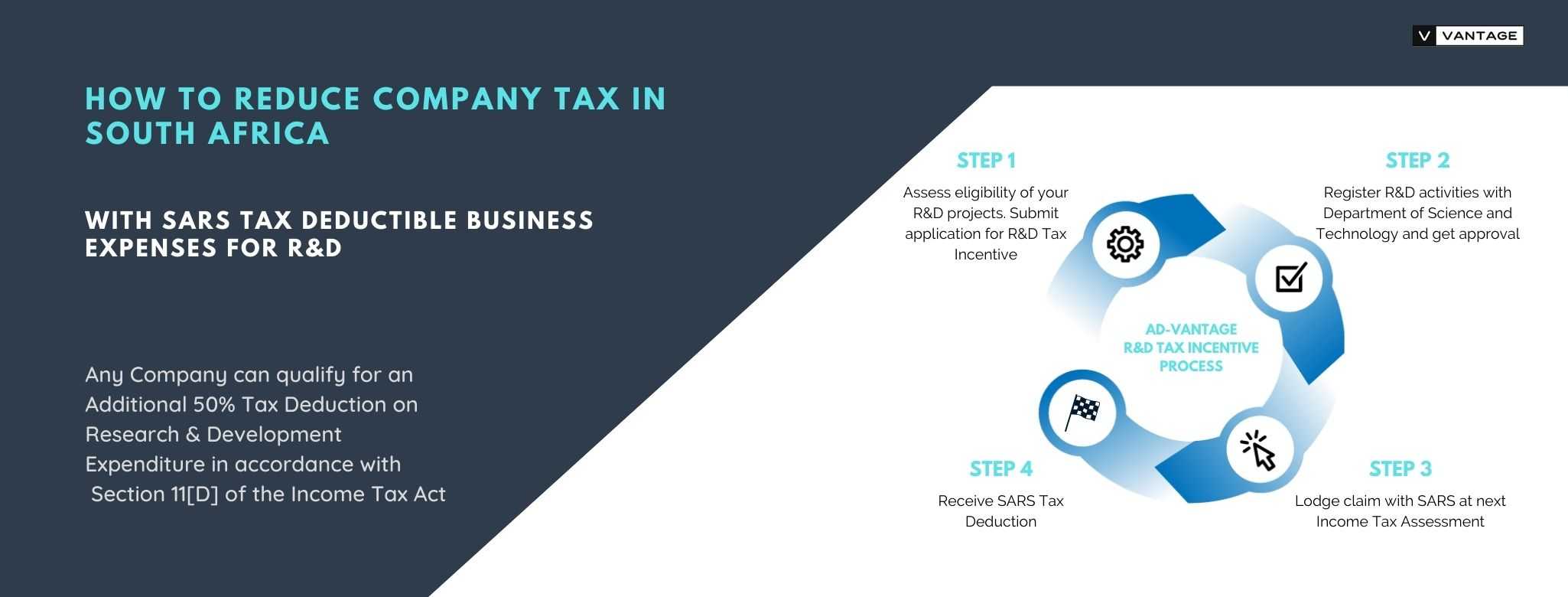
Companies in South Africa can qualify for the R&D Tax Incentive by following a simple process.


Qualifying expenses that are tax deductible under the R&D Tax Incentive in South Africa:

There are some of the R&D cost categories that qualify as business expenses that qualify for an additional 50% tax deduction. These expenses cover your healthcare innovation expenses from the idea development to the end of the development phase, or transfer of technology or until the start of the commercialisation phase:

  1. People: Salaries, wages, employers pension contributions
  2. Subcontractors: Using third parties to help solve the technological uncertainty
  3. Consumables: Raw materials consumed in the prototyping and testing process
  4. Software: Software employed as part of the R&D project


Have questions? Contact Vantage

R&D Tax Incentive | A Must-Read For Any Company Conducting R&D in SA

Why companies need to apply for the R&D Tax Incentive in SA

R&D Tax Incentive | A Must-Read For Any Company Conducting R&D in SA

Every company conducting R&D in South Africa must seriously consider the R&D Tax Incentive as an opportunity to reduce their tax liability and boost their cash flows. During tough economic times, as we have now, this is of considerable value to any business that conducts Research and Development. The incentive is open to companies of all sizes in virtually any sector of the SA economy.  There is no minimum threshold or cap to the tax allowance.

The R&D Tax Incentive is provided for in Section 11[D] of the Income tax Act. It allows your company to deduct an additional 50% on Operational R&D Expenses from taxable income. This reduces your taxable income. The R&D Tax Incentive translates to an effective 14% reduction in SARS income taxes.

In order to qualify for the R&D Tax Incentive, you need to apply to the Department of Science and Innovation, before you start the R&D project. The R&D Tax Allowance is open to businesses of any size, in any sector of the economy. You have to be a registered taxpayer with SARS. The R&D activities must be conducted here in South Africa. Once approved you receive an application number.


“The hardest thing in the world to understand is the income tax.”

Albert Einstein


So, what is the R&D Tax Incentive [also known as the Scientific and technological Research and Development Tax Incentive]?

South Africa’s Research and Development as a percentage of GDP needs to move towards the target of 1.5% – regarded as the minimum required to help us to compete globally. This target was set in the National Development Plan for achievement by 2030. The aim of this incentive is to encourage South African companies to invest in research and development.

The government introduced Section 11D into the Income Tax Act. This tax incentive enables a taxpayer to claim an allowance with respect to Research & Development (R&D) expenses.

All R&D expenses automatically qualify for a 100% deduction. The South African R&D Tax Incentive provides an additional 50 % ‘super’ tax deduction for certain R&D expenses. This translates to a net 14% income tax benefit. This means if a company spends R1 million on eligible R&D, its tax liability to SARS will be reduced by R140 000. For the investor or shareholder, the main effect is to increase the after tax return on investment. At a corporate tax rate of 28%, the incentive benefit translates into a benefit of 14c for every rand spent on R&D, thus reducing the marginal cost of R&D


What other deductions are available for companies conducting R&D in South Africa?

Section 11D provides another incentive that relates to capital equipment acquired specifically for Research and Development. An accelerated depreciation allowance is provided for capital R&D expenditure on building, machinery, plant, implement, utensil or article. In terms of this accelerated depreciation allowance, 50% of the cost of the asset may be claimed in the year during which the asset is first brought into use, 30% in the subsequent year and 20% in the year thereafter.


“Collecting more taxes than is absolutely necessary is legalized robbery.”

Calvin Coolidge


What are the company requirements to qualify?

To be eligible, a company must be an incorporated entity and recognised as a company under the Income Tax Act. Individuals, non-profit organisation and trusts are not eligible.

In order to qualify, the company [taxpayer] must comply with the following requirements for the expenditure to qualify for the 150% allowance.

  1. The R&D expenditure must be conducted as part of your normal business and trading activities.
  2. The R&D activities must be conducted in South Africa.
  3. The R&D project and activities must need certain criteria as defined in Section 11D


What happens in the case where R&D is funded by third parties or grants from government. Can I still qualify for the R&D Tax Incentive?

A company that funds R&D undertaken by another company can qualify for R&D tax deduction, provided that the funded company does not claim. A company can also claim a deduction for R&D that it outsources to a South Africa university or science council. Companies in joint ventures (JVs) can claim to the extent that they fund the R&D.

Section 11D(7) acknowledges that a firm can receive other funding from government, public entity or municipality towards its R&D activities.  An amount equal to such a funding will be excluded when the R&D tax deduction is calculated. This is to ensure that only the R&D expenditure incurred by the company qualifies. A company cannot claim for the R&D tax deduction of 150% for the amount of a government grant for the R&D expenses.


What is Research and Development [R&D]?

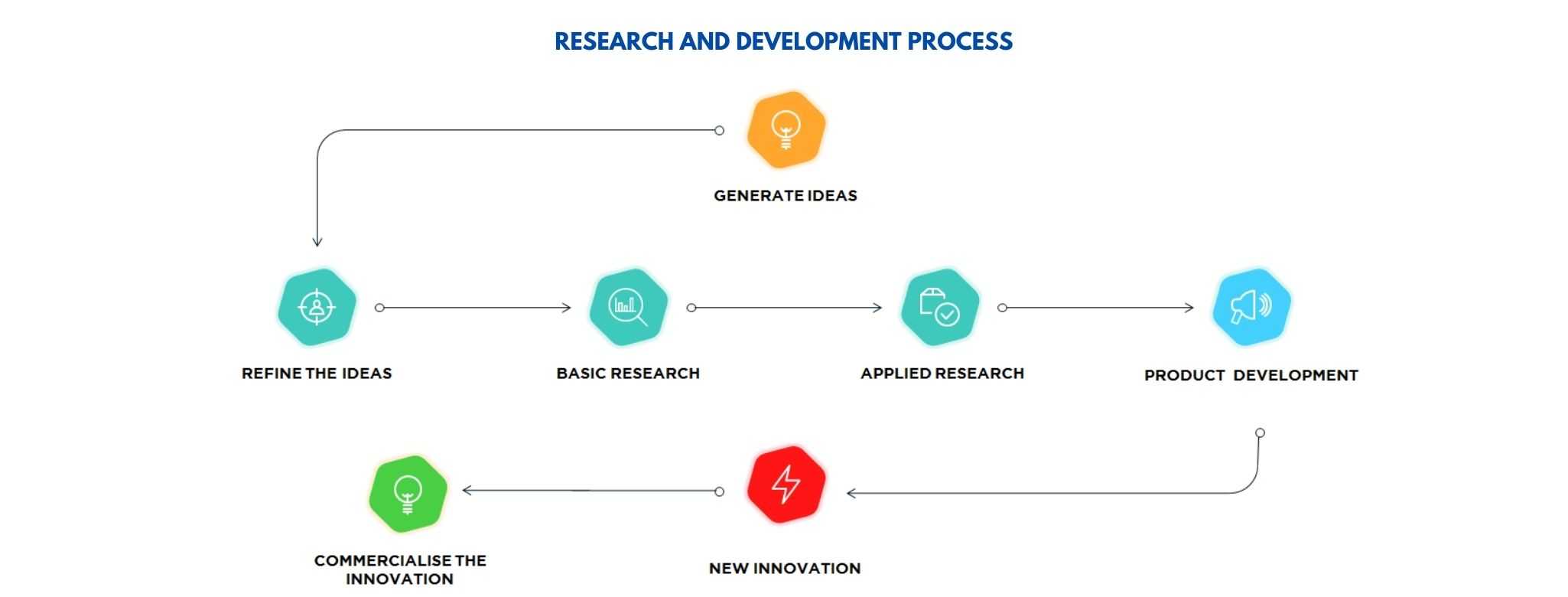
Research and Development Process - R&D Tax Incentive South Africa

What is Research and Development [R&D]?

Research and Development plays a key role in driving innovation.


The aim of R&D is to discover or create new knowledge. The new knowledge is then applied to create new products, processes, and services.


Innovation, in a business context, seeks to introduce something new. One way it achieves this is by transforming an idea together with knowledge from R&D into a product or service. This in turn creates value for which customers will pay.


R&D is an important contributor to innovation. This can lead to a company developing a competitive advantage.


Is my company undertaking R&D?

R&D does not only take place in a laboratory. Nor does it only take place at Tesla or SpaceX or Apple. R&D is taking place whenever a company looks to improve something or come up with something new. By investigating new materials, ingredients and components, we can innovate. This innovation leads to improved functionality, reduced costs and improved performance. R&D is taking place in almost every industry from FMCG, Healthcare, Engineering, Software, and so on.


“Today, it takes more brains and effort to make out the income-tax form than it does to make the income.”

Alfred E. Neuman


What is R&D?

The aim of academic R&D is to get new knowledge. This new knowledge may or may not be applied to practical uses.


The aim of industrial R&D is to get new knowledge that is relevant to the company’s business needs. The application of this knowledge leads to new and improved products, processes, systems or services. Once again, these innovations can increase the company’s sales and profits.


The National Science Foundation (NSF) defines three types of R&D:


  1. Basic research
  2. Applied research
  3. Development


BASIC RESEARCH is aimed at advancing scientific knowledge but does not have a specific commercial goal


APPLIED RESEARCH is research directed to the discovery of new knowledge. This has specific commercial objectives on products, processes, or services.


DEVELOPMENT is the systematic application of the knowledge, discoveries or understanding gained from research toward the production of useful materials, devices, systems, or methods. This includes the design and development of prototypes and processes


It may be appropriate to distinguish between development and engineering. We could say that engineering is the application of state-of-the-art knowledge to the design and production of marketable goods.


Research creates the knowledge, and development designs and builds prototypes and proves their feasibility. Engineering then converts these prototypes into products that can be offered to the marketplace or into processes that can be used to produce commercial products and services.


What is R&D activity?

A difficulty remains in determining whether an activity is regarded as an R&D activity.


According to the Frascati Manual (2015), a R&D activity is distinguished from a non-R&D activity if five core criteria are satisfied. The activity must be:


  • novel – aimed at new findings


  • creative – based on original, non-obvious concepts and hypotheses


  • uncertain – there is uncertainty on whether the final outcome is achievable


  • systematic – it needs to be structured, planned and budgeted for


  • transferable and/or reproducible – leads to results that could be reproduced


According to the Frascati Manual (2015) “All five criteria must be met, at least in principle, every time an R&D activity is undertaken whether on a continuous or occasional basis.”


What are R&D capabilities?

R&D can be conducted in-house, under contract with external service providers, or with others entities. In-house R&D affords a strategic advantage: the company is the sole owner of the knowledge and technology created and can protect it from unauthorized use. R&D is also a learning process. In-house research thus develops capability, by training the company’s own R&D people.


External R&D is usually contracted out to academic institutions, specialised non-profit research institutions, or external contractors. These entities often have experienced personnel in the disciplines of science and technology. The downside is that the company will not enjoy the learning experience and may become dependent on the contractor. Using universities can be a cost-efficient approach, and may benefit both parties as students and academic professionals can get exposure to industries, and build long-term partnerships.


Through joint R&D, several companies with shared interests join together to perform R&D, either in a separate organisation or in a university. The advantages are lower costs, since each company does not have to invest in similar equipment, researchers or resources. One of the downsides may be that all the sponsors have access to the same knowledge and technology.


“A person doesn’t know how much he has to be thankful for until he has to pay taxes on it.”

Anonymous


Factors influencing R&D

Research and development are usually thrown together as one concept, but in reality they are somewhat distinct processes. Research is considered to be science-oriented whereas development is the mechanism for translating the science into commercial products and services. Basic science can be thought of as the engine for pushing new discoveries and ideas into society – Science Push. This is in contrast to the concept of market pull. Market pull is the process of translating the basic science into products and services to meet customer needs, wants, and demands. The interaction between science push and market pull creates a very powerful feedback loop that spurs on the development and diffusion of new products and services.


How is R&D linked to innovation?

R&D activities are a subset of innovation. R&D represents the activities that companies undertake to help innovate and introduce new products and services or to improve their existing offerings. The outcome of R&D may lead to patents, designs or copyrights as discoveries and inventions are made, and products or services created.


An innovation is a new or improved product or process (or combination thereof) that differs from the firm’s previous products or processes and that has been made available to potential users (product) or brought into use by the firm (process).


A product innovation is a new or improved good or service that differs from the firm’s previous goods or services and that has been introduced on the market.


Innovation activities include all developmental, financial and commercial activities undertaken by a firm that are intended to result in an innovation for the firm.